Models 是最重要的部分 计划仔细讲一下
计划分别花一天看rendering, models 还会顺便看看dino的架构
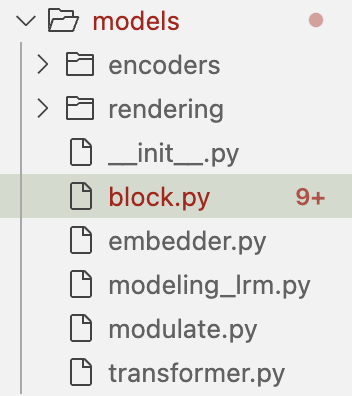
block.py
1. Basic attention block
LayerNorm1 + Self + LayerNorm2 +
MLP :
(2* (Linear(Inner_dim → mlp_ratio倍 再回归)+Dropout))
2. Cross attention block(take in cond)
同时每个attend或mlp之前有residual
LayerNorm1 + Cross + LayerNorm2 + Self + Layernorm3 +
MLP :
(2* (Linear(Inner_dim → mlp_ratio倍 再回归)+Dropout))
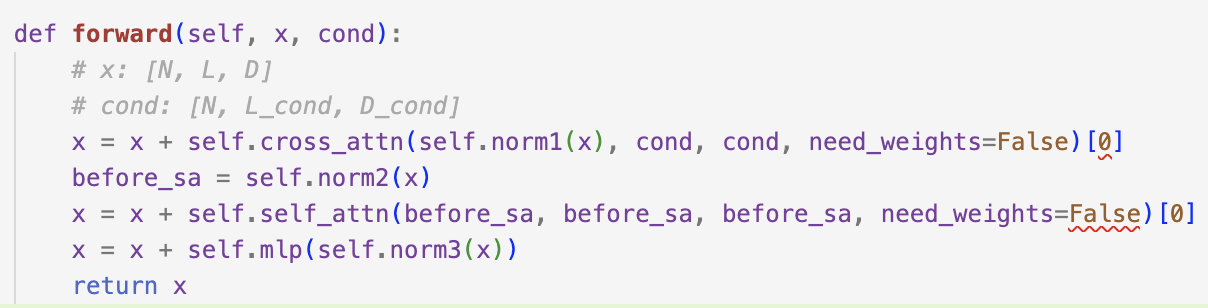
注意cross-attention的定义 包含kdim和vdim 都是condition的值
self.cross_attn = nn.MultiheadAttention(
   embed_dim=inner_dim, num_heads=num_heads, kdim=cond_dim, vdim=cond_dim,
	 dropout=attn_drop, bias=attn_bias, batch_first=True)
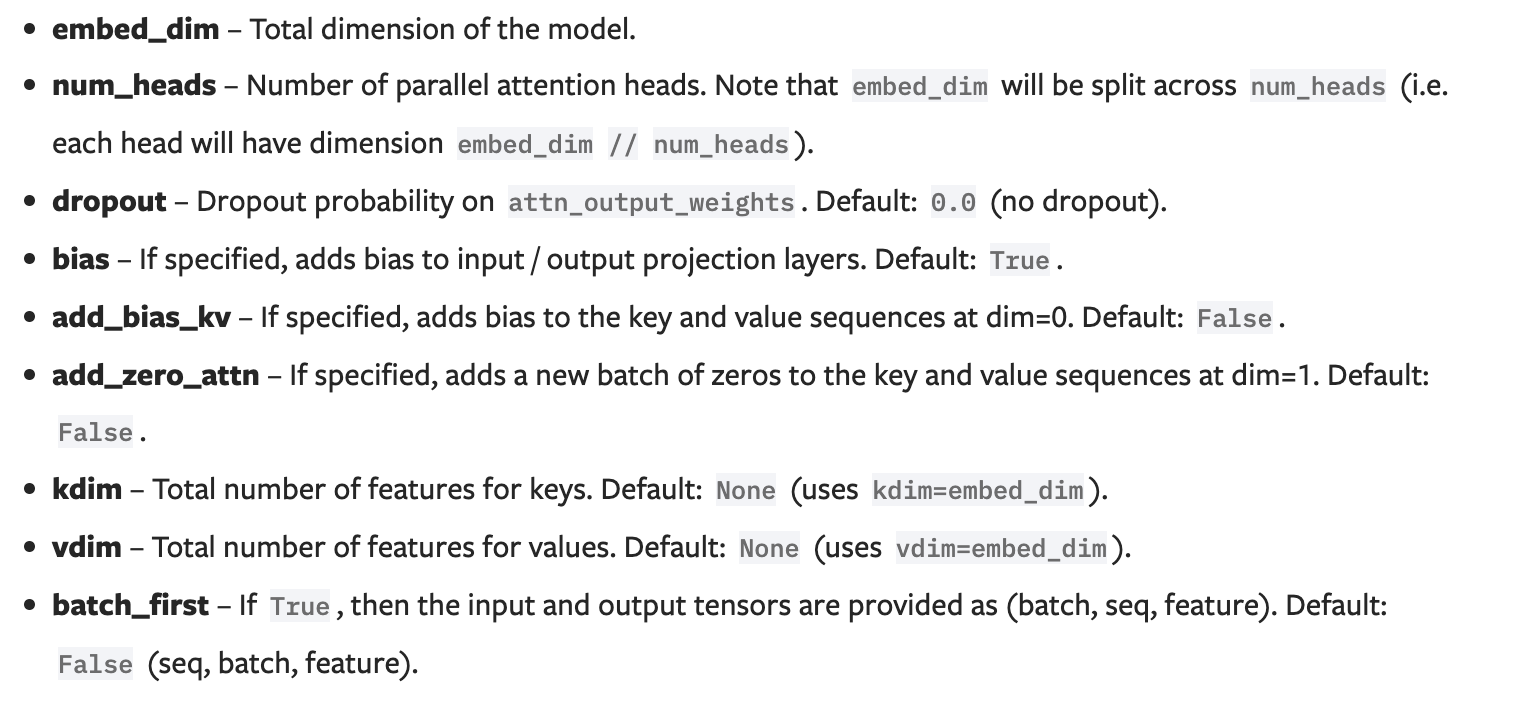
最后总结一下nn.MultiheadAttention所需参数
embed_dim, num_heads, kdim(opt), vdim(opt),
dropout, bias, batch_first()
**这里k,v 的dim其实可以不一样
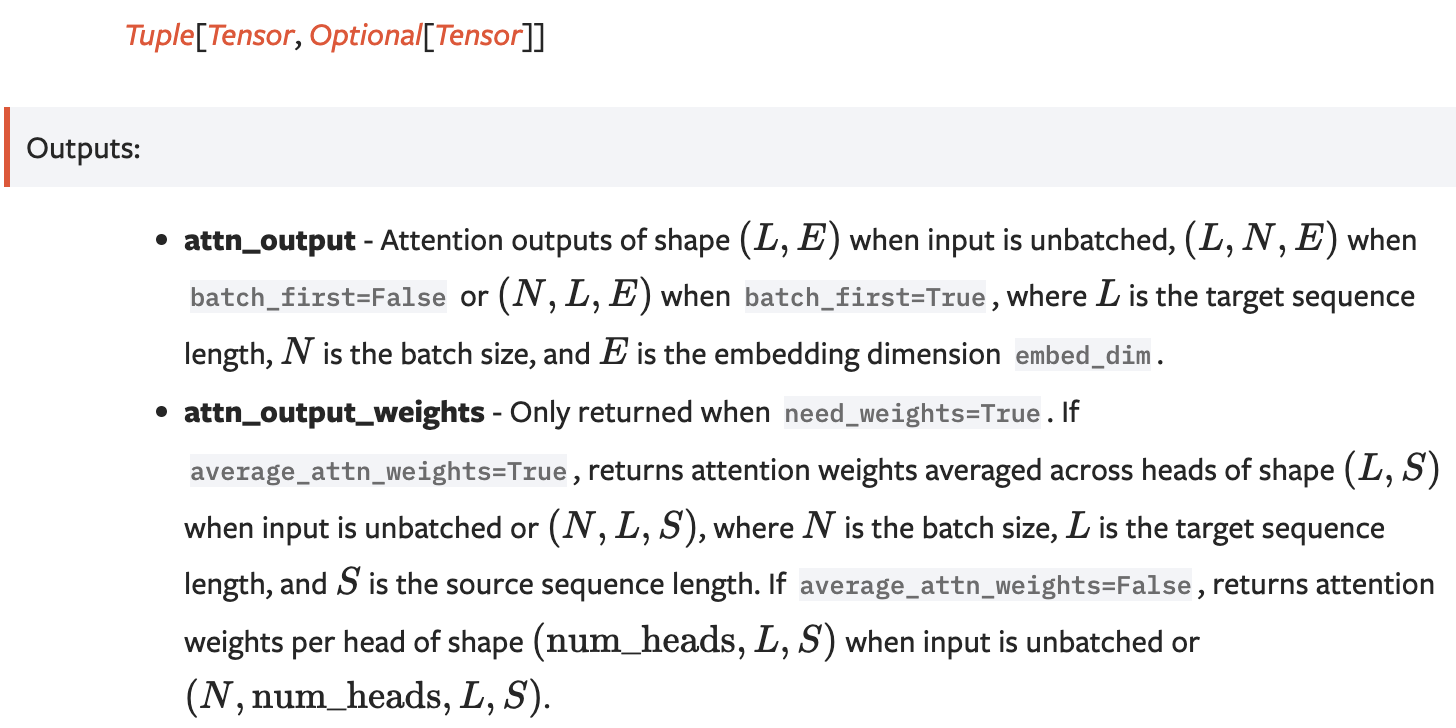
atten(q,k,v,need_weights)

Return type → self_attend()[0]
3. Condition Modulation Bloack
包含condition + modulation(:调整) vectors
mod会作用在norm上
将layernorm 替换成了ModLN
class ModLN(nn.Module):
    """
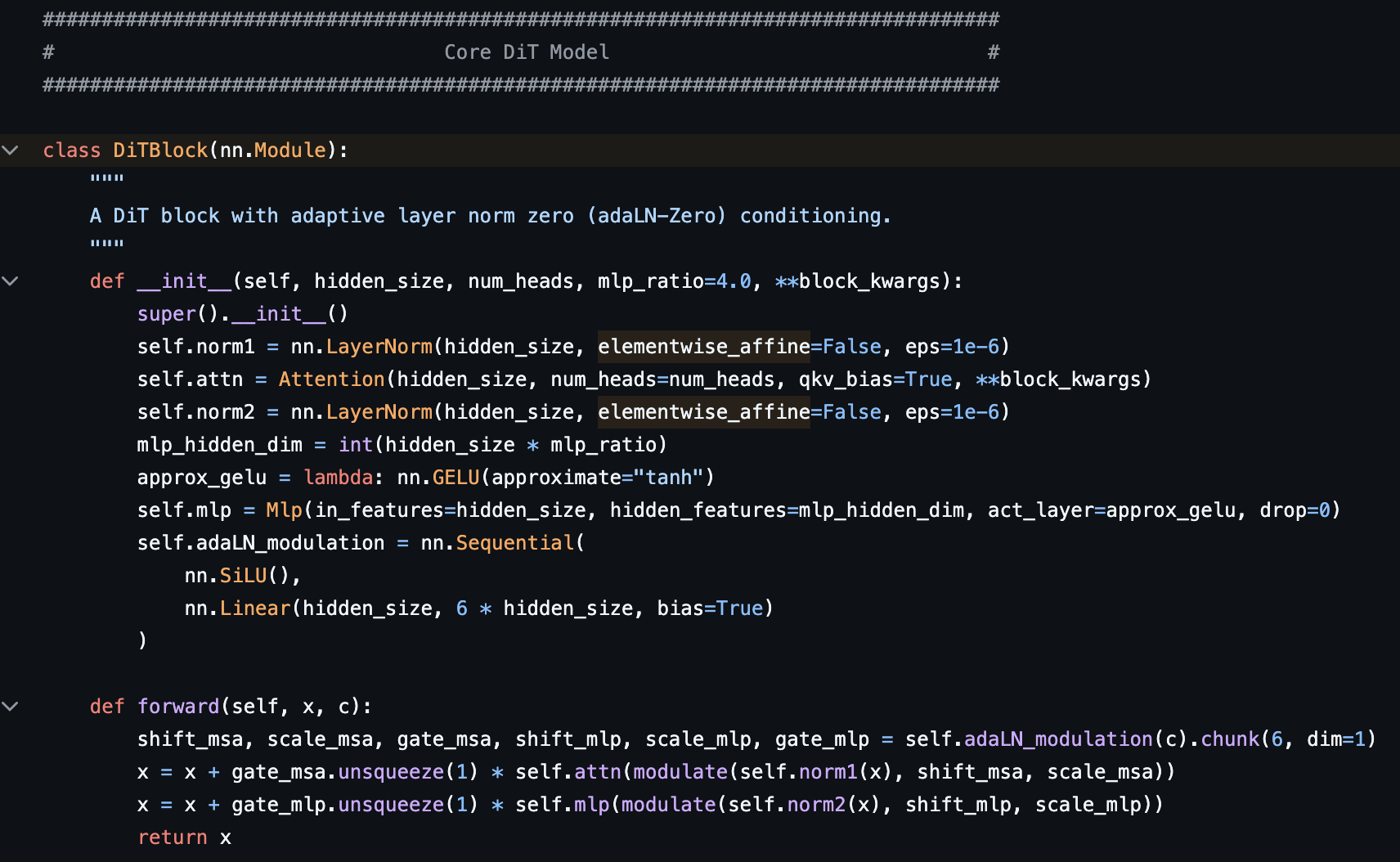
    Modulation with adaLN(adaptive layer norm zero (adaLN-Zero) conditioning).

    References:
    DiT: https://github.com/facebookresearch/DiT/blob/main/models.py#L101
    """
    def __init__(self, inner_dim: int, mod_dim: int, eps: float):
        super().__init__()
        self.norm = nn.LayerNorm(inner_dim, eps=eps)
        self.mlp = nn.Sequential(
            nn.SiLU(),
            nn.Linear(mod_dim, inner_dim * 2),
        )

    @staticmethod
    def modulate(x, shift, scale):
        # x: [N, L, D]
        # shift, scale: [N, D]
        return x * (1 + scale.unsqueeze(1)) + shift.unsqueeze(1)

    def forward(self, x: torch.Tensor, mod: torch.Tensor) -> torch.Tensor:
        shift, scale = self.mlp(mod).chunk(2, dim=-1)  # [N, D]
        return self.modulate(self.norm(x), shift, scale)  # [N, L, D]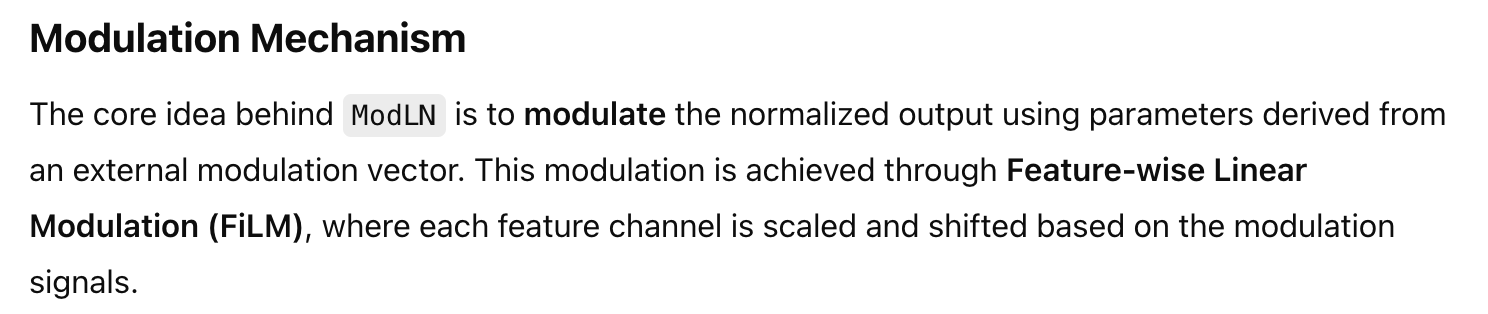
根据mod生成shift&scale
这里用modulation做norm
原本implement在DIT中
Scalable Diffusion Models with Transformers (DiT)
We train latent diffusion models, replacing the commonly-used U-Net backbone with a transformer that operates on latent patches
TransformerDecoder
process the input(with condition and modulation)
assert a, ”b” assertion error of b
from accelerate.logging import get_logger

logger = get_logger(__name__)
logging.basicConfig(level=logging.DEBUG,
format='%(asctime)s - %(levelname)s - %(message)s')

#set 更高level 阻止一般debug的log
logging.basicConfig(level=logging.INFO)
logger.debug() 申明当前状态
logger.info()
create all blocks with the same block type and put them in forward pass one by one
create all block instances with(dim and cond_dim) with partial
    def forward_layer(self, layer: nn.Module, x: torch.Tensor, cond: torch.Tensor, mod: torch.Tensor):
        if self.block_type == 'basic':
            return layer(x)
        elif self.block_type == 'cond':
            return layer(x, cond)
        elif self.block_type == 'mod':
            return layer(x, mod)
        else:
            return layer(x, cond, mod)

    def forward(self, x: torch.Tensor, cond: torch.Tensor = None, mod: torch.Tensor = None):
        # x: [N, L, D]
        # cond: [N, L_cond, D_cond] or None
        # mod: [N, D_mod] or None
        self.assert_runtime_integrity(x, cond, mod)
        for layer in self.layers:
            x = self.forward_layer(layer, x, cond, mod)
        x = self.norm(x)
        return x
LRM model
def __init__(self, camera_embed_dim: int, rendering_samples_per_ray: int,
                 transformer_dim: int, transformer_layers: int, transformer_heads: int,
                 triplane_low_res: int, triplane_high_res: int, triplane_dim: int,
                 encoder_freeze: bool = True, encoder_type: str = 'dino',
                 encoder_model_name: str = 'facebook/dino-vitb16', encoder_feat_dim: int = 768):
1. Get encoder
self.encoder = self._encoder_fn(encoder_type)(
            model_name=encoder_model_name:'facebook/dino-vitb16',
            freeze=encoder_freeze:True,
      )

@staticmethod
def _encoder_fn(encoder_type: str):
    encoder_type = encoder_type.lower()
    assert encoder_type in ['dino', 'dinov2'], "Unsupported encoder type"
    if encoder_type == 'dino':
        from .encoders.dino_wrapper import DinoWrapper
        logger.info("Using DINO as the encoder")
      return DinoWrapper
    elif encoder_type == 'dinov2':
        from .encoders.dinov2_wrapper import Dinov2Wrapper
        logger.info("Using DINOv2 as the encoder")
      return Dinov2Wrapper
Camera embedding
self.camera_embedder = CameraEmbedder(
            raw_dim=12+4, embed_dim=camera_embed_dim,
        )
Convert raw camera dim(为什么12+4) to camera_embed
from the DIT without pos_embedding
class TimestepEmbedder(nn.Module):
		"""
		Embeds scalar timesteps into vector representations.
		"""
		def **init**(self, hidden_size, frequency_embedding_size=256):
			super().**init**()
			self.mlp = nn.Sequential(
			nn.Linear(frequency_embedding_size, hidden_size, bias=True),
			nn.SiLU(),
			nn.Linear(hidden_size, hidden_size, bias=True),
			)
			self.frequency_embedding_size = frequency_embedding_size

		@staticmethod
		def timestep_embedding(t, dim, max_period=10000):
		    """
		    Create sinusoidal timestep embeddings.
		    :param t: a 1-D Tensor of N indices, one per batch element.
		                      These may be fractional.
		    :param dim: the dimension of the output.
		    :param max_period: controls the minimum frequency of the embeddings.
		    :return: an (N, D) Tensor of positional embeddings.
		    """
		    # <https://github.com/openai/glide-text2im/blob/main/glide_text2im/nn.py>
		    half = dim // 2
		    freqs = torch.exp(
		        -math.log(max_period) * torch.arange(start=0, end=half, dtype=torch.float32) / half
		    ).to(device=t.device)
		    args = t[:, None].float() * freqs[None]
		    embedding = torch.cat([torch.cos(args), torch.sin(args)], dim=-1)
		    if dim % 2:
		        embedding = torch.cat([embedding, torch.zeros_like(embedding[:, :1])], dim=-1)
		    return embedding

		def forward(self, t):
		    t_freq = self.timestep_embedding(t, self.frequency_embedding_size)
		    t_emb = self.mlp(t_freq)
		    return t_emb
Pos embedding
self.pos_embed = nn.Parameter(torch.randn
(1, 3*triplane_low_res**2, transformer_dim)
***** (1. / transformer_dim) ** 0.5)
1, total_pixiel_count * 3(planes), transformer_dim
triplane_low_res → H, W of each triplane image
camera_dim → transformer_dim
总结一下
-
image_feature = encoder(image) (dino) → encoder_feat_dim
-
camera_embedding = camera_embedder(camera)
D_cam_raw(16) → camera_embed_dim
- Transformer
pos_embed → (cond_MHA + modulation_norm)
(N, L = triplane_dim= 3*width^2, transformer_dim)
→ (N, L, )
- Plane generation
x = tokens.view(N, 3, H, W, transformer_dim)
回归triplane图片 dim
x = x.contiguous().view(3 * N, transformer_dim, H, W) # Shape: [3*N, transformer_dim, H, W]Upsampling
*self*.upsampler = nn.ConvTranspose2d(transformer_dim, triplane_dim, kernel_size=2, stride=2, padding=0)triplane_dim = 3维 每张图片 深度dim (例如64)
kernal size & stride = 2 Double image size
x = self.upsampler(x)  # [3*N, D', H', W']
x = x.view(3, N, *x.shape[-3:])  # [3, N, D', H', W']
x = torch.einsum('indhw->nidhw', x)  # [N, 3, D', H', W']
planes → (N, 3, D, H*, W*) H*, W* = 2H, 2W
- Synthesize(Render)
render_results = *self*.synthesizer(planes, render_cameras, render_anchors, render_resolutions, render_bg_colors, render_region_size)render_results = self.synthesizer(
planes,
render_cameras, # Shape: [N, M, D_cam_render] #rendering cam parameter(specific viewpoints)
render_anchors, # Shape: [N, M, 2]
render_resolutions, # Shape: [N, M, 1]
render_bg_colors, # Shape: [N, M, 1]
render_region_size # Integer
)Output → rendered images (N, M(camera pos count), C_img(3?), H, W)
Summary of Dimensions at Each Stage
- Input Image:
- Shape:
[N, 3, H_img, W_img]
- Shape:
- Image Features:
- After Encoder:
[N, encoder_feat_dim]
- After Encoder:
- Camera Embeddings:
- After Camera Embedder:
[N, camera_embed_dim]
- After Camera Embedder:
- Transformer Input:
- Positional Embeddings Repeated:
[N, L, transformer_dim]
- Positional Embeddings Repeated:
- Transformer Output (Tokens):
- Shape:
[N, L, transformer_dim]
- Shape:
- Tokens Reshaped for Planes:
- Before Upsampling:
[N, 3, H, W, transformer_dim] - After Reordering:
[3*N, transformer_dim, H, W]
- Before Upsampling:
- Upsampled Planes:
- After Upsampler:
[3*N, triplane_dim, 2*H, 2*W]
- After Upsampler:
- Final Planes:
- Reshaped Back:
[N, 3, triplane_dim, 2*H, 2*W]
- Reshaped Back:
- Rendered Images:
- Shape:
[N, M, C_img, H_render, W_render]
- Shape:
Role of Camera and Image Dimensions
- Image Dimensions:
- The input images are encoded into a compact feature representation, capturing the visual content.
- The feature vector is used to condition the transformer, influencing the generation of triplanar features.
- Camera Dimensions:
- Raw camera parameters are embedded into a feature space.
- These embeddings modulate the transformer, allowing it to account for viewpoint information during plane generation.
- Transformer Integration:
- The transformer combines positional embeddings, image features, and camera embeddings to produce tokens that represent triplanar features.
- The sequence length
Lis directly related to the resolution of the triplanes.
- Plane Generation:
- Tokens are reshaped and upsampled to create high-resolution triplanar feature planes.
- These planes encapsulate 3D information and are used for rendering novel views.